

Architect the System — Then the Space
The certification for everyone in charge of establishing an innovation center, hub, lab, or experience center
Up to 90% of corporate innovation labs fail — because they are designed as places, not as systems. CADhIA™ teaches the craft that makes the difference: six design decisions, made in order, from strategy anchor to activation. Start with the 2-hour online course for USD 19.
Innovation centers. Design centers. Experience centers. And regional development programs, where the environment is a platform rather than a building. The same six decisions apply to all four — with different answers. No design background required.One Craft — Four Arenas
Designed as places, not as systems
In the landmark O'Hare study, three of six corporate innovation hubs were dead within three years of opening — despite considerable resources. The pattern repeats everywhere: the building gets the budget; the operating model, the location logic, and the experience get an afterthought. Visitor counts replace output metrics, the parent organization stops understanding what happens inside, and the budget is quietly cut in year two.
The fix is the theme of the entire certification: form follows system. Decide the strategic anchor, the operating model, and the location first — then the space becomes the physical interface of your Innovation Management System, aligned with ISO 56001:2024.

Both paths cost roughly the same in year one. The showpiece is not cheaper — it just spends in the wrong order. The entire difference is the order of decisions, and who is still standing in year three.
Magnus Penker, CEO Innovation360, co-author of Innovation by Design
The CADhIA™ Method — Six Decisions, Made in Order
1. Anchor
The strategic question, the mandate, and the link to the parent's growth strategy — written as one sentence.
2. Model
The I-MOVABLE operating model and the financial model: who decides, who pays, who owns the budget in year two.
3. Place
Four proximities — talent, customers, parent, ecosystem — decided on a 10-year horizon.
4. Space
Four zones, the flows, and all the senses: light, acoustics, materials, scent, hospitality, wayfinding.
5. Experience
The visit choreographed in five acts, measured as a revenue engine.
6. Activate
Thought experiment → AI sandbox → pretotype → prototype → pilot. The building arrives last.
The Evidence Behind the Craft
What You Get and How It Works
Level 1 — Fundamentals (online, 2 hours, USD 19). A full recorded course with complete narration — not a teaser: why environments fail, the survivor playbook, all six decisions with worked examples — including a fully completed I-MOVABLE canvas on a real turnaround case — the anchor statement template, the location checklist, zoning with the flows-and-senses layer, the five-act visit, and the experiment ladder. 11 quizzes and downloadable templates. Certificate of completion available for USD 29. The online course will soon be available on my360.global.
Levels 2–4 (live, 3 × 6 hours, USD 995 per level and seat). Delivered in-company for your team, or through one of our certified partners — cohorts capped at 20. You make the six decisions on your own real case — a corporate center, a public hub, or a regional program — supported by the Agent Impact AI coach 24/7, the full template kit, and the case library with floor plans. Level 4 ends with your written blueprint, personally graded, and the final exam.
The CADhIA™ certificate is awarded after completing all four levels, the written blueprint, and the final exam — a diploma is issued per completed level, but the certified role requires all four. Digital badge via Accredible, valid for life.
Certification Outcome
Levels 2–4 — Your Case, Decision by Decision
Three instructor-led live levels, 6 hours each — in-company or via one of our certified partners, cohorts capped at 20. You work on your own real case throughout — a corporate center, a public hub, or a regional program — with the Agent Impact AI coach 24/7 and homework with personal feedback between levels. USD 995 per level.
Level 2 — Anchor, Model & Location
You write and defend your anchor statement live. You complete the full I-MOVABLE operating model with governance designed to prevent the black box, choose the financial model with a named year-2 budget owner, and make the location decision with the seven-question checklist and a 10-year rationale. For regional programs: ESF/ERUF project funding vs. permanent platform economics. Homework: one coherent draft, AI-coach reviewed.
Level 3 — Architecture & Experience
You turn the research into defensible design arguments, produce a zoning concept with a flow diagram and a sensory program of requirements (light, acoustics, materials, scent, hospitality, wayfinding) ready to brief an architect, and script a full five-act visitor journey with revenue-engine metrics. Deep case walkthroughs with floor plans: Fortune 500 i3 Labs, Koenigsegg, the premium reseller, and the Prysmian Experience Centre.
Level 4 — The Blueprint
You design the experiment ladder for your case (thought → AI sandbox → pretotype → prototype → pilot), draft the activation roadmap with proof points instead of opening dates, and assemble all six decisions into one board-ready blueprint. You present and defend it under structured peer review and instructor challenge — then the written blueprint (personally graded) and the final exam. Certificate and badge: valid for life.
Ready to architect environments that survive year three?
Start with Level 1 today for USD 19 — two hours, the complete method. The online course will soon be available on my360.global. Continue to the certification track whenever you are ready: USD 995 per level, Levels 2–4.
Innovation & Design Centers
The internal engine and the creation environment: operating models that prevent the black box, governance across business units, prototyping shops that feed the pipeline — judged by output, never by visitor counts.
Experience Centers
The customer encounter as a revenue engine: five-act choreography, co-creation rooms adjacent to the stage, 48-hour follow-up discipline — built on two decades of briefing-center evidence and proven in practice with the Prysmian Experience Centre — concept with Central Saint Martins, London, interior realized with Wingårdhs.
Regional Development Programs
Innovation environments without a single building: Innovation360 ran the innovation module of GrowKomp (22 SMEs, four municipalities, ESF-funded) and won its successor EVOLVE 2.0 (30 SMEs, 2026–2029, with Jönköping University). The six decisions apply unchanged.
Built, Not Theorized — Inside the Prysmian Experience Centre
The method on this page is not a model on a whiteboard. Innovation360 developed the Prysmian Experience Centre concept with students from Central Saint Martins, London, and the interior was realized with Wingårdhs, with the Experience Man by Ebba Penker (designer) — a twelve-room choreography from the entrance carpet to the factory door.
A twelve-room choreography, every sense briefed
Visitors follow a staged journey: entrance and passage with a new rounded wall and signage, lounge with decorative lighting and draperies, the experience room with a custom-designed tiered sofa and roller-blind staging, the AR experience room with a bespoke light installation, the exhibition and laboratory room, the workshop room — and finally the factory entrance, where the visit walks straight into production.
The story is told on the walls: a timeline of 150+ years of cable history runs the length of the room, with a glowing cable as the narrative thread — above blue product tables where visitors handle the actual cables. Form follows system: every room serves the five-act visit. Three details from the build:
- Sensory specification, zone by zone: nine floor materials matched to each room's role — including the Prysmian logo looped into the entrance carpet — premium acoustic panels, and lighting tracks with special fixtures per zone.
- Custom pieces where the choreography demands it: the tiered sofa, the storage wall, and the 'Experience Man' display were purpose-designed; exhibition furniture from Swedese, Flokk — and a special table by Ragnars, a GrowKomp alumni company.
- The journey continues outdoors: guiding tree and ground lighting from the parking to the door — the visit starts before the entrance, exactly as the five-act method teaches.
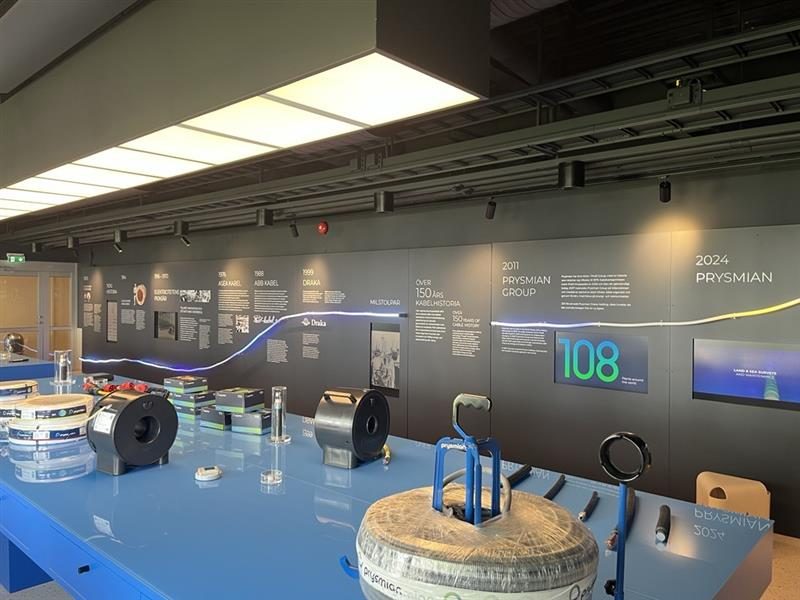
Co-Lab: Wingårdhs Architects × Innovation360 × Ebba Penker (designer)
The craft on paper — from the joint design work behind the Experience Centre. Every drawing dimensioned before anything was built.
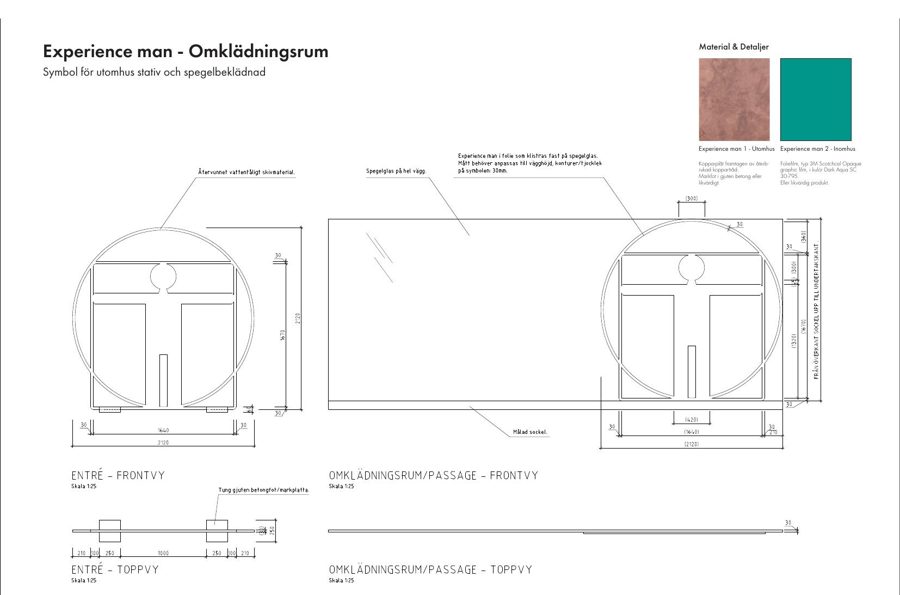
“Experience Man”
The welcome figure with a QR-coded chest. Design © Ebba Penker (designer).
View drawing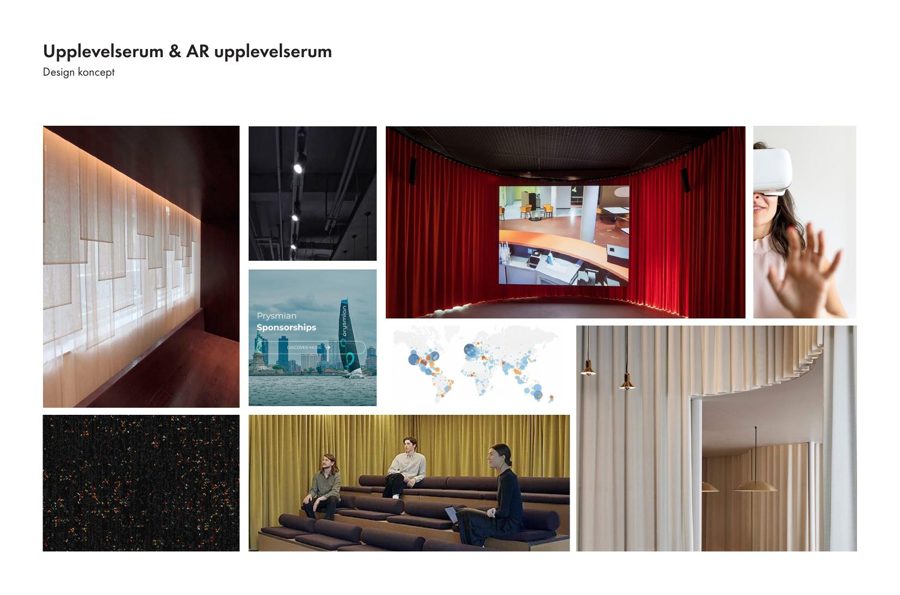
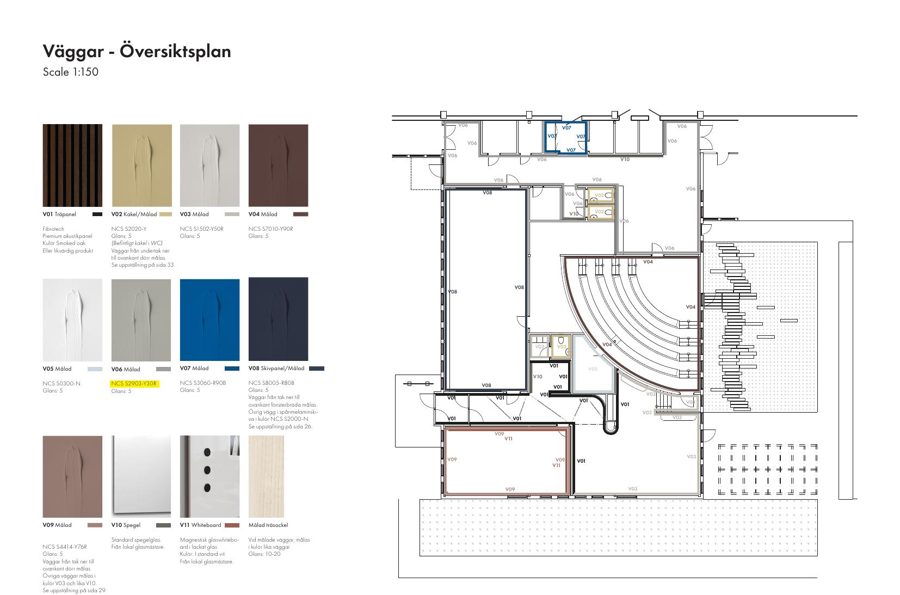
Nine Floor Materials
Nine floor materials, zone by zone — the logo looped into the entrance carpet.
View plan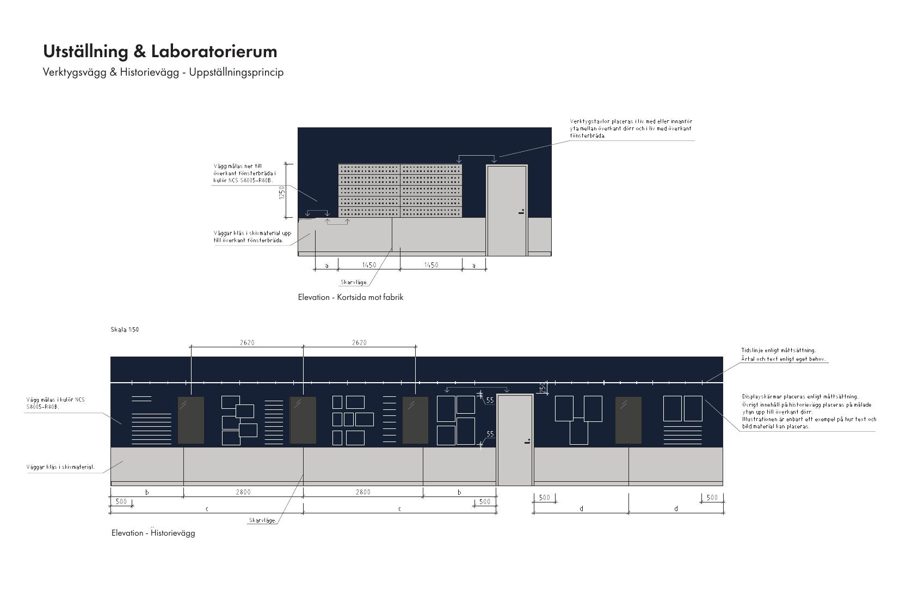
The Experience Man
A Vitruvian welcome figure — the human at the center of every designed environment, arms open in a T-pose inside the classic circle and square, with a QR-coded chest that opens the digital layer of the visit. One figure, three jobs: it greets, it tells the design philosophy (people first, geometry second), and it links the physical room to the digital journey.
That is what a signature piece is for — and why the method says: custom where the choreography demands it. Design © Ebba Penker (designer).
Architect the system — then the space.
The CADhIA™ principle
For everyone in charge of establishing an innovation environment
No design background and no software prerequisites. The certification is built for the person who owns the assignment — corporate or public.
- Chief Innovation Officers, heads of innovation, and lab directors building or rescuing a center
- Science park, innovation district, and incubator leadership professionalizing the environment
- Municipal and economic development officers running regional innovation programs
- University hub and accelerator directors connecting academia and industry
- Briefing program and experience center managers turning visits into revenue
- Consultants, corporate real estate, and workplace strategists advising the builders
Next cohort — limited to 20 seats
Level 1 you take on your own, online and self-paced (soon on my360.global). Levels 2–4 run in-company or via a certified partner, in live cohorts capped at 20 to keep your case in focus. Certification is valid for life.
An Optional Path Beyond CADhIA™ — the Licensed Practitioner Accreditation
CADhIA™ is a standalone certification. For those who want the full Innovation360 methodology — all tools, all belts, official LP status, and access to the global network — the Licensed Practitioner accreditation is the next step. Four belts building from IMBA to Black Belt, each recognised by Harvard, Oxford, and IEEE.
IMBA — Basic
3-day online bootcamp. Foundation in innovation management and the Innovation360 framework.
IMYB — Yellow Belt
Applied practitioner. Run assessments and guide client engagements with full tool access.
IMGB — Green Belt
Senior practitioner. Lead complex engagements, transformation programmes, and portfolio work.
IMBB — Black Belt
Master practitioner. Innovation Connectivity, Mega Polls, faculty path. Stockholm in-person grading.
The LP accreditation is separate from the CADhIA™ certification — and complementary. Certified architects can pursue LP accreditation to gain access to the full Innovation360 tool suite, platforms, and global community. Accredited Licensed Practitioners can add CADhIA™ to deepen their craft in designing innovation, design, and experience environments — and many combine it with the Certified ISO 56000 Advisor credential.
Questions about CADhIA™ or a cohort for your team?
Talk to us about enrollment, in-company cohorts, or how the certification fits your innovation program. We respond within one business day.
Build the environment your strategy deserves
Join the first generation of Certified Applied Design Hub Innovation Architects — and bring the blueprint to your board.