A Decade of Innovation Data: What Surprised Us Most

Ten years ago, the team at Innovation360 Group began the journey towards understanding and systemizing the truths about innovation capability and innovation management. We reviewed academic research from the world’s thought leaders, worked with leading innovators, and codified the best thinking across the globe. This was the basis of the development of Innovation360’s innovation framework and tools starting with InnoSurvey®, now one of the most robust data stores on innovation capability in the world.

Our understanding continues to evolve. As we have gathered additional insights and experience working with innovators all over the world, including private, public sector and academia, we have deepened our grasp on innovation management principles and truths and what leaders do and do not do to optimize innovation results.

In a recent review of our framework and data we asked ourselves two questions: What are some core observations that have we made over the past 10 years (i.e., patterns, dependencies, behaviours, etc.)? And, what stands out? Our goal? To identify ‘teaching moments’ for our practitioners and clients using our data and experience with successful innovators. More about that at the end of this piece.

Patterns of Behaviour – Evidence of Misalignment

As a first step, our review looked at reported behaviour based on the Why-What-How framework we espouse in our books. Overall, we saw evidence of high aspirations but the capability systems that would be necessary to make them real were often structurally missing or contradictory.

For example, organizations say that they innovate and report ‘substantial efforts to innovate’ but also report that the ‘how’ capabilities needed to deliver systemically are underdeveloped. The result, innovation exists as an aspiration but not a repeatable system.

Innovators tend to favour incremental improvements, short term ROI and low-risk projects, with radical efforts often under-supported. In effect, they get stuck in Horizon 1 and starve Horizon 2 and 3 for resources.

Innovation tends to happen in silos, with weak cross-functional collaboration. Innovation depends on a few individuals or units rather than the entire system.

Many organizations depend on traditional market research and internal assumptions with few excelling in deep customer insight and co-creation. This leads to innovations that are technically sound but misaligned with real needs.

Organizations report weak learning loops which involve some level of testing without institutionalized learning. In practice, innovators fail to factor pilot results into future decision-making or the broader innovation ecosystem. The ‘how’ of learning, I.e., pilot testing and test methodologies are often weak. In effect, organizations experiment, but do not learn fast enough.

Innovation focuses on creating something new, with less attention to levers like pricing, IP, and differentiation. This results in efforts that create value but fail to capture it with gaps in pricing and visualization of advantages.

Leaders support innovation rhetorically but avoid uncertainty. Internal tension exists between leadership styles and the assessment of risk. This recreates ‘safe innovation’ that rarely leads to breakthroughs.

LinkedIn
X (Twitter)
Facebook

We then looked at our data to identify examples where we could further quantify these misalignments using the responses of both innovators and non-innovators across more than 10,000 organizations globally. Seven examples stood out – with some surprises. We describe them below.

  1. Embarking without a map
  2. Operating with a competitive blind spot
  3. Behaving in a risk-averse manner
  4. Failing to ‘test and learn’
  5. Innovating in isolation
  6. Ignoring incentives
  7. Flying blind

1: Embarking Without a Map

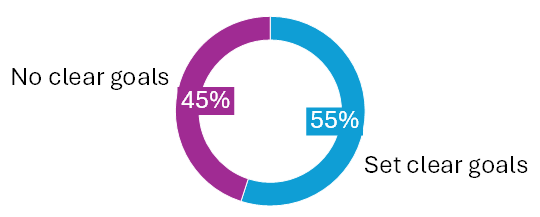
Setting clear targets is a basic and accepted tenet of management. But our data reveals a surprising reality: about 4 in 10 organizations have no clear innovation goals.

In fact, goals are often entirely absent and only 55% of organizations affirm that they set innovation goals and work systematically toward them – meaning 45% do not.

Over the years, many have cited success/failure rates for change and innovation programs (e.g., HBR reports that from 70 to 90% fail, and MIT more recently cited a 95% failure rate for generative AI pilots). It is not much of a stretch to surmise that the lack of roadmaps as a major root cause of failed innovation programs. Without clear goals, even substantial innovation efforts (which 75% claim to make) must drift.

Leadership needs to translate innovation ambitions into a roadmap with specific, measurable goals. Doing so aligns teams and resources and increases the chances that innovation investment yields strategic results instead of aimless experimentation.

2: Operating With a Competitive Blind Spot

As Steve Jobs said, “You can’t look at your competition and say you’re going to do it better. You must look at the competition and say you’re going to do it differently.”

Seems like a logical conclusion. But 10 years of data tells us that few firms analyse rivals regularly, with few organizations understanding or keeping a close eye on their competition.

According to our data below, only 53% of organizations say they regularly evaluate their competitors’ products and innovations. That means half do not know what competitors are doing. This is surprising – one would think competitive intelligence is standard practice, especially for innovation leaders who need to benchmark and differentiate their offerings. Instead, these organizations operate with a kind of competitive blind spot, focusing inward and reacting late to market moves.

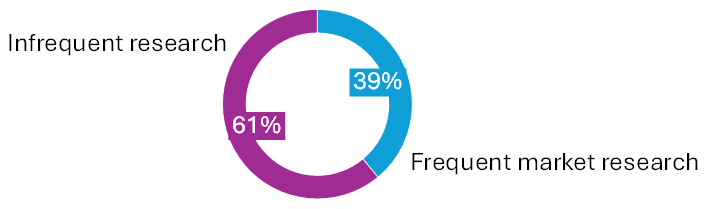
Similarly, only about 39% conduct frequent market research on themselves and competitors to estimate market potential as shown below, reinforcing that proactive market sensing is not as common as we assumed.

The fact is that organizations that neglect competitor and market analysis risk being blindsided. To innovate effectively, organizations need to regularly scan their external environment – not to copy rivals, but to learn from them and spot opportunities or threats. Establishing an innovation radar (e.g., competitive product teardowns, trend scouting, customer behavior analysis) can inform better strategic decisions. Emphasizing the value of sharing ideas with others is crucial, as such openness can strengthen and advance innovative concepts. In a fast-paced landscape, the biggest revelations in innovation often come from outside one’s own four walls.

3: Behaving in a Risk-Averse Manner

We have found that success over the long run, comes from organizations who build portfolios of innovation efforts with varying levels of risk and the assurance of both short-term results and long-term viability. A simple measure of risk is the proportion of radical vs incremental innovation. To our surprise only 50% of organizations surveyed innovate for radical changes and improvement. While popular rhetoric also suggests that organizations must take ‘moonshots’ and accept failure, the data shows most organizations are highly risk-averse in their innovation cultures and portfolios.

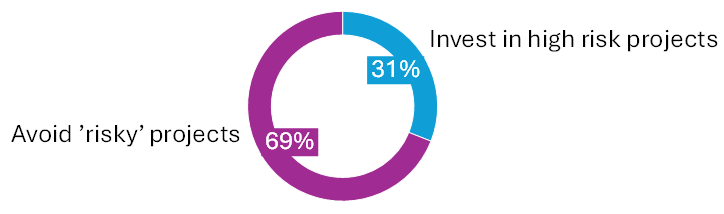
When we look at our data below, the results are clear that only 31% of organizations say they invest in high-risk, potentially high-reward innovation projects. A full 69% admit they avoid projects that might not return the investment.

The data also suggests that the common assumptions that large organizations routinely fund risky R&D or disruptive ventures are false. The majority stick to safer, incremental innovations – enhancing existing products or operational efficiencies – rather than bet on radical ideas. This is counterintuitive given how much business literature extols risk-taking as essential for breakthrough innovation.

A ‘too-conservative’ approach can be perilous overall. Organizations that never take calculated risks may fall prey to disruption by bolder competitors or startups. Leaders should examine whether their innovation portfolios have the right balance of core improvements vs. transformative ‘shots on goal.’ Building a culture that can tolerate some failure – through small experimental budgets or venture-style funding for innovative ideas – is crucial. Otherwise, the safest path today could lead to obsolescence tomorrow.

4: Failing to Test and Learn

Our work shows that iterating, testing, and piloting innovative ideas is key to lowering risk, gaining feedback, cutting costs, and boosting adaptability. These practices allow for continuous improvement by testing small, manageable versions of an idea, learning from failures, and adjusting before a full-scale launch. This cycle of build, test and refine helps teams to identify problems early, build better solutions, and pivot effectively when needed, fostering innovation and better outcomes. It also enables teams to embrace uncertainty, and to apply these testing techniques to far more uncertain H2 and H3 initiatives.

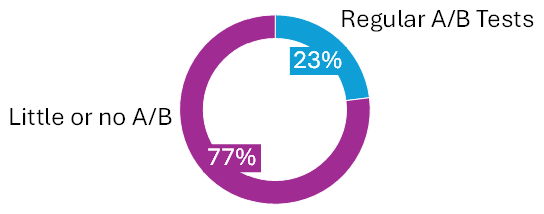
Surprisingly, many of these practices are not followed. For example, despite the buzz around ‘fail fast’ culture, only 23% of organizations conduct regular A/B tests on new innovations, with 55% pilot testing innovations. Fewer than half have a formal process to prototype ideas or a methodology to test and fix errors early. This is strikingly counterintuitive – one would assume most firms rigorously experiment before launch, yet the data shows a major gap. Rather, many organizations launch products without robust testing, relying more on ‘gut feeling’ than formal feedback.

Instead, innovation leaders should foster structured experimentation (e.g., pilot programs, A/B tests, prototyping) to validate ideas. Closing this gap can prevent costly failures and accelerate learning, turning ‘fail fast’ from a slogan into standard practice.

5: Innovating in Isolation

Collaboration is critical for meaningful innovation results. By combining skills and perspectives, organizations can harvest better outcomes, foster shared ownership, and leverage collective intelligence to capture breakthrough results.

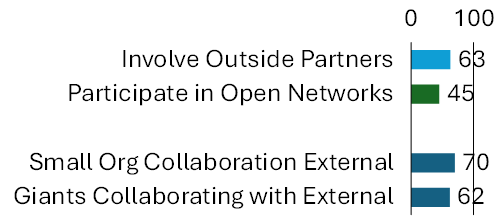
External collaboration is another area where reality defies our expectation. Open innovation is a popular idea, yet a large share of companies still ‘go it’ alone. Only 63% of organizations involve outside partners (like universities, startups, or suppliers) in their innovation efforts, and just 45% participate in open innovation networks. In other words, half of organizations do not tap into external sources of innovation – a counterintuitive finding given the widespread praise of co-creation and ecosystem innovation.

One might assume big organizations, with more resources, forge the most partnerships; instead, many large organizations remain closed. Surprisingly, smaller organizations collaborate more than large ones: about 70% of small organizations (<50 employees) partner externally, versus only 62% of giants (>5000 employees) in our sample.

Organizations that limit external collaboration are missing fresh ideas, agility, and market insights. Embracing open innovation – through strategic partnerships, innovation hubs, or developer communities – injects new knowledge and capabilities that internal R&D alone might lack.

6: Ignoring Incentives

A healthy innovation culture includes recognition and rewards for creative efforts.

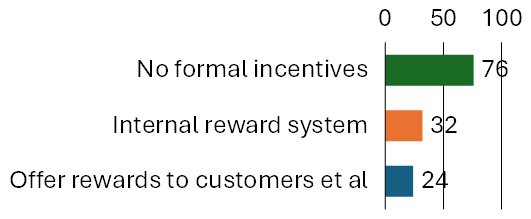
Surprisingly, half of organizations provide no formal incentives for innovation. And only 32% have an internal reward system in place to encourage innovation work. This is counterintuitive as you would expect organizations to motivate intrapreneurs with bonuses, awards, or career incentives, but the majority do not.

And just 24% of organizations offer rewards to customers or external contributors who help innovation, indicating that most firms are not incentivizing outside collaboration either. The absence of rewards points to a cultural disconnect where management expects employees to innovate in addition to their normal responsibilities yet receive no additional motivation or incentives.

When these signals are absent, employees concentrate solely on their main responsibilities that leadership recognizes and rewards, neglecting the pursuit of daring or innovative initiatives. If innovation is truly a priority, leaders should reinforce it by recognizing and rewarding those who contribute. Simple steps like innovation awards, bonuses tied to new idea implementation, or public recognition can signal that the company values innovative behavior.

7: Flying Blind

“You can’t manage what you don’t measure,” as the saying goes – yet half of organizations do not measure their innovation performance at all.

Just 46% report spending time and resources to formally review launched innovations’ outcomes (post-launch learning) – meaning half never formally evaluate how their new products or initiatives fared. Incredibly, 65% have no routine evaluation of how customers use and experience innovation, nor what efforts would refine them.

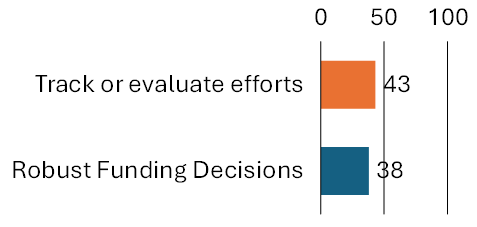
This reality is highly unexpected given today’s data-driven management culture. One would assume most companies set innovation KPIs (like R&D ROI, innovation pipeline value, or time-to-market) and review them regularly. Instead, many firms are flying blind: they invest in innovation without clear metrics of success or feedback loops. In addition, just 38% say they have an effective process for choosing which innovation projects receive funding at every stage.

The absence of metrics makes it difficult to learn and improve. Innovating organizations should implement basic innovation accounting – from tracking the percentage of revenue from new products to running post-mortems on innovation projects. Without measuring results (i.e., successes and failures), organizations risk repeating mistakes or underinvesting in what works. Instituting even a simple innovation scorecard can sharply improve accountability and outcomes.

What Should You Do With This Information?

The insights in this paper illustrate the often-counterintuitive truths about innovation capability, reminding leaders that closing the gap between knowing innovation best-practices and following them remains a critical challenge. This analysis is based on 10 years of data collected from around the world. Key findings are derived from Innovation360 Group’s global innovation management database that encompasses responses from over 10,000 organizations.

Our review asked two questions: What observations stand out in what we have learned over the past 10 years (i.e., patterns, dependencies, behaviours, etc.)? And what did we find surprising?

Our goal was to identify potential ‘teaching moments’ that we can use in dialogue with our clients and practitioners and clients in helping each to improve their understanding and overall innovation performance. We describe several misalignments and evidence in the data as to the potential root causes. In each we lay out some rudimentary observations about what actions might be taken to respond to each. The Seven Surprises outlined above provide a helpful framework for that dialogue.  As such, we have developed a series of introductory webinars that address each one, and a corresponding Master Class that combines all seven in a formal learning environment.

Stay tuned for more information on these webinars and courses.

Sources:

InnoSurvey® data (2016–2025).

How to Assess and Measure Business Innovation, The Complete Guide to Business Innovation, Penker et al, 2017

Innovation By Design, Innovation Management Systems for Global Impact, Penker & Purcell, 2024

State of AI in Business 2025, MIT NANDA initiative, MIT Media Lab.

How Corporate Purpose Leads to Innovation, HBR November 2023

LinkedIn
X (Twitter)
Facebook