
Increasing your speed to market requires a holistic thinking from idea to commercialization. A major reason why organizations struggle to deliver on time is either because they make the projects consistently bigger or because they are jamming too many projects in the same system. Find out how to not be one of those organizations by reading more on the topics below.


Innovation Strategy in Seven Steps: From Aspiration to Audit-Ready
Strategy · Guide
Most organizations do not lack innovation activity — they lack an innovation strategy. InnoSurvey® data from more than 10,000 organizations in 105 countries shows that roughly 45 per cent set no clear innovation goals at all, and the rest often stop at a slide. This guide lays out innovation strategy in seven steps, pairs each step with the failure mode it is designed to prevent — filmed as the Seven Secrets live sessions — and ends where serious strategies now end: audit-ready under ISO 56001.
In this article
- Why innovation strategy fails before it starts
- Step 1 — Set direction and measurable goals
- Step 2 — Scan the field with structured foresight
- Step 3 — Choose the three to six capabilities that matter
- Step 4 — Balance the portfolio across three horizons
- Step 5 — Fund evidence, not fiction
- Step 6 — Open the system
- Step 7 — Reinforce what you want repeated
- Make it auditable: innovation strategy and ISO 56001
Why innovation strategy fails before it starts
Strategy documents rarely fail on logic. They fail on omission: a goal with no map, a map with no outside view, a portfolio with no appetite for risk, a process that funds conviction instead of evidence. Over a decade of assessing innovation capability, Innovation360 has seen the same handful of failure modes recur so reliably that we filmed a live session on each one — the Seven Secrets series on The Home of Innovation.
The seven steps below are the positive print of those negatives. Each step exists because skipping it produces a known, measurable failure. Run them in order once a year, re-steer quarterly, and the output is not a slide — it is an operating logic that connects aspiration, foresight, capabilities, portfolio, governance, ecosystem and incentives into one coherent whole, the same logic we laid out in Coherent innovation strategy.
Exhibit 1
Step 1 — Set direction and measurable goals
An innovation strategy starts with a decision, not a brainstorm: where will growth come from, how much of it must come from new products, services and business models, and by when? The number matters. A target like “20 per cent of revenue from offerings younger than three years” forces every later choice — portfolio, funding, hiring — to line up behind it. Without the number, innovation becomes a cost line to defend instead of a growth engine to steer.
45%
of organizations have no clear innovation goals at all, across more than 10,000 organizations assessed with InnoSurvey® — the single most common reason innovation work drifts. See A decade of innovation data.
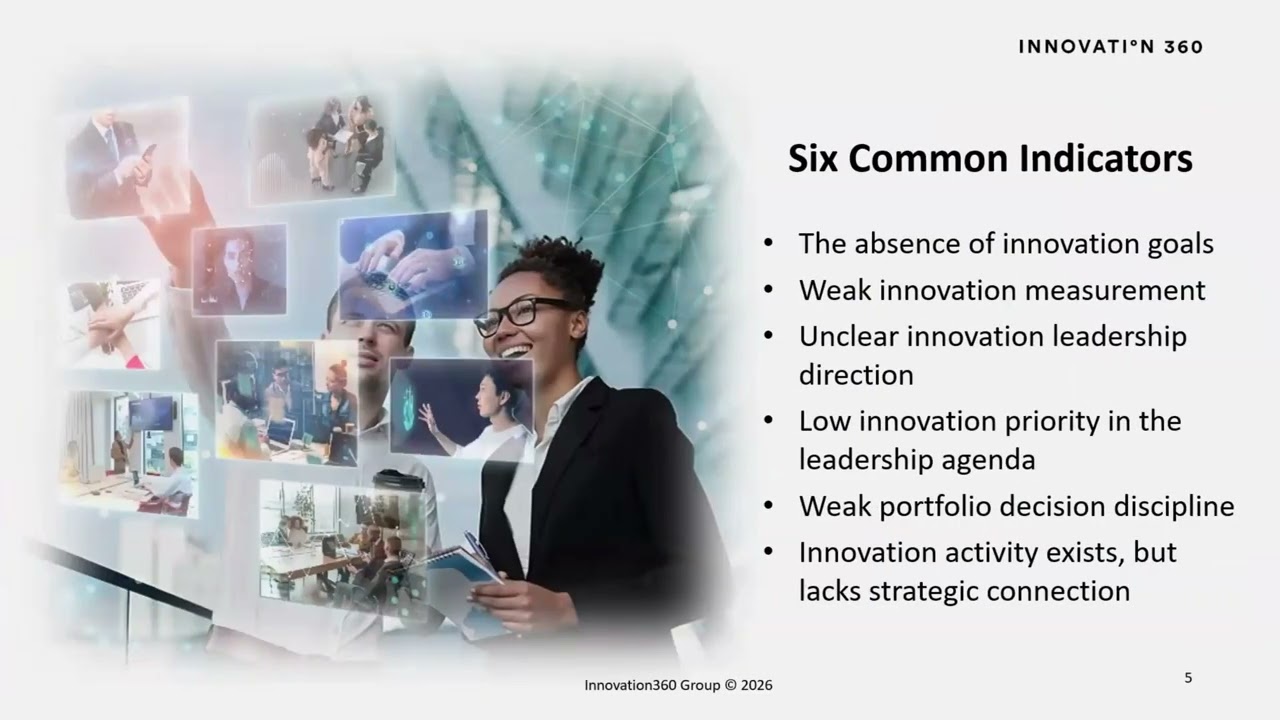
The failure mode here is embarking without a map: activity everywhere, direction nowhere. The cure is to write the aspiration down, translate strategy into an innovation map with explicit goals, and set up the governance that will carry it — exactly what the first Seven Secrets session walks through.
 Watch · Seven Secrets, Session 1Embarking Without a MapHow leaders set measurable innovation targets, turn strategy into an innovation map, and stand up governance.
Step 2 — Scan the field with structured foresight
Strategy made purely from the inside is autobiography. More than half of organizations do not systematically evaluate their competitors, and only 39 per cent run regular market research — which means most strategies are written with a competitive blind spot built in.
The fix is structured, repeatable scanning rather than heroic offsites: collect drivers through the seven PESTLED lenses (Political, Economic, Social, Technological, Legal, Environmental, Demographic), score them by importance and certainty, and sort every driver into one of four verdicts — act, prepare, watch, park. The full method is in Intelligent Foresighting, the tooling in PESTLED360, and the scenario craft — stretching critical uncertainties into futures you can steer by — in Scenario planning in practice.
 Watch · Seven Secrets, Session 2Operating with a Competitive Blind SpotWhy internally optimized organizations miss outside signals, the five stages of innovation maturity, and two first steps.
Step 3 — Choose the three to six capabilities that matter
Spending more does not make you more innovative. Booz & Company’s Global Innovation 1000 found no statistically significant relationship between R&D spend and financial performance; what predicted performance was alignment between innovation strategy, business strategy and capabilities. Companies with tightly aligned innovation strategies showed around 40 per cent higher operating income growth and twice the total shareholder return of less-aligned peers — the coherence premium at work.
Practically, that means assessing your current capability profile honestly — this is what InnoSurvey® and the Wheel of Innovation are built for — and then choosing the three to six differentiating capabilities you will deliberately build, fund and measure. Everything else is table stakes or noise. The full capability logic, including the six-link coherence chain from strategic intent to differentiated outcomes, is in Innovation Capabilities: From Uncertainty to Advantage.
Step 4 — Balance the portfolio across three horizons
With direction, outside view and capabilities in place, the portfolio question becomes answerable: how much goes to improving the core (H1), how much to adjacent moves (H2), and how much to transformative options (H3)? The three horizons model is not a budget formula — it is a discipline for making risk appetite explicit instead of accidental.
Accidental is the norm. InnoSurvey® data shows only about half of organizations innovate for radical change at all, and roughly 31 per cent invest in high-risk, high-reward projects. That is rarely a courage problem; it is a system-design problem. Risk-averse behaviour follows predictably when prototyping, pilot testing, structured risk assessment and rewards for new knowledge are missing — the four capabilities that make bigger bets safe to take.
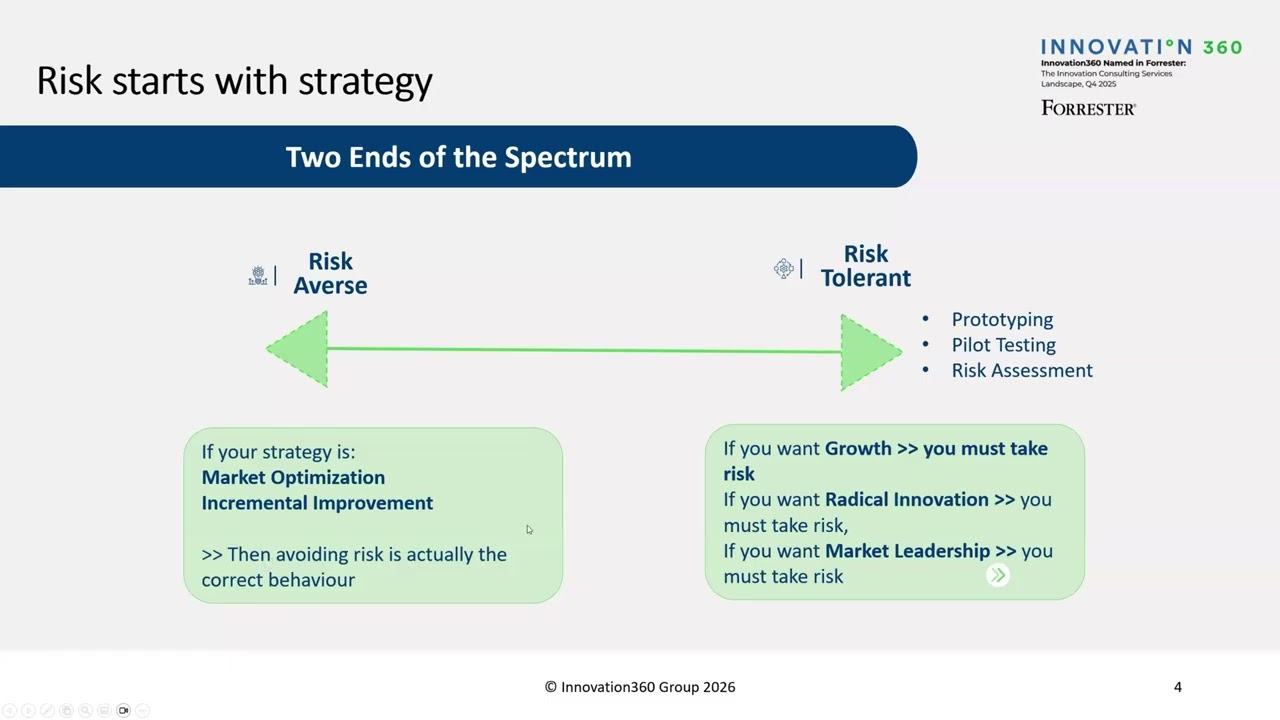 Watch · Seven Secrets, Session 3Behaving in a Risk Averse MannerWhy risk aversion is a design flaw, not a character flaw — and the four capabilities that de-risk bigger bets.
Step 5 — Fund evidence, not fiction
A strategy is only as good as its funding mechanism. The governance rule that separates functioning innovation systems from theatre is simple: money follows evidence. Stage the funding, define what must be true at each gate, kill or pivot when the evidence says so, and let business cases earn their way from hypothesis to scale. Our guide to the stage-gate process, modernized shows how to run gates that work across all three horizons without strangling H3 options in H1 paperwork.
23%
of organizations actually A/B-test their assumptions — everyone else is, to some degree, funding fiction. From a decade of InnoSurvey® findings.
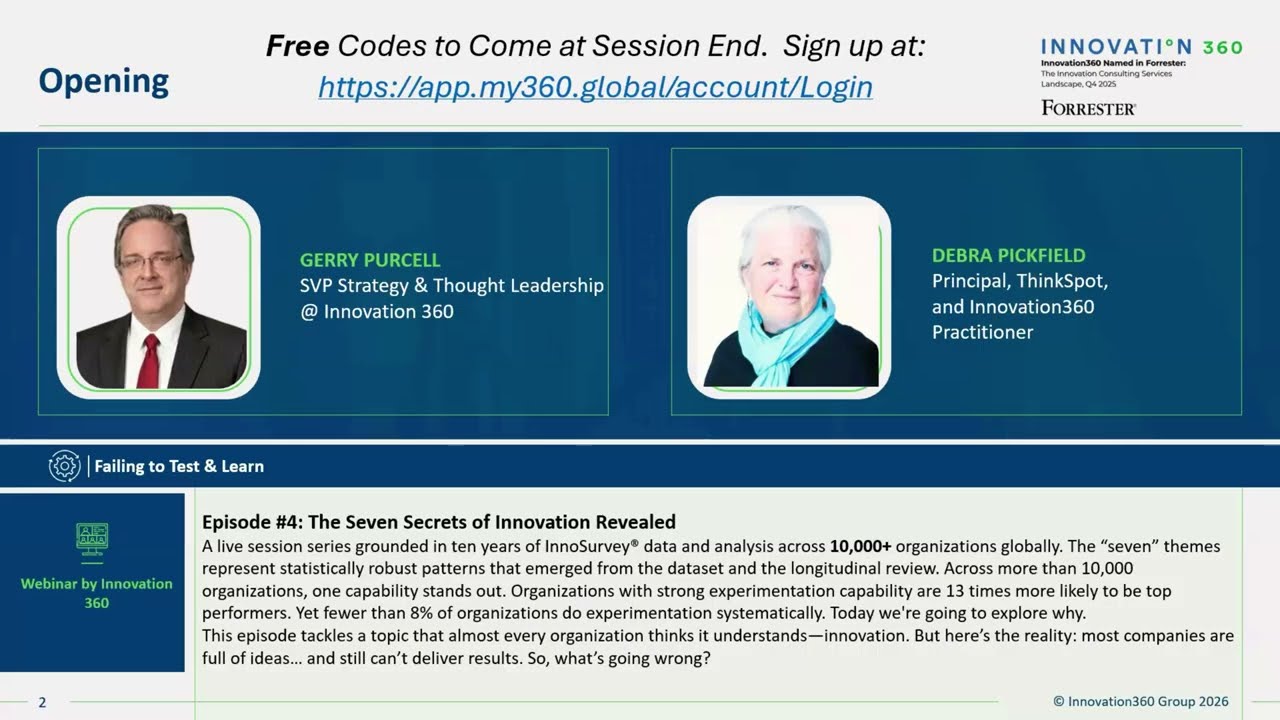 Watch · Seven Secrets, Session 4Failing to Test and LearnBuilding the test-and-learn muscle: hypotheses, experiments and the discipline of changing your mind on evidence.
Step 6 — Open the system
No strategy survives contact with the market alone. InnoSurvey® data shows 63 per cent of organizations work with outside partners, but only 45 per cent take part in open innovation networks — and, counter to intuition, smaller organizations collaborate externally more than large ones. The gap between “we have partners” and “we systematically source ideas, technology and validation from outside” is where innovating in isolation hides inside organizations that believe they are open.
The strategic decision in this step: which parts of your innovation agenda you will deliberately run with partners, networks, startups and customers — and how you will tell genuine ecosystem work from innovation theatre.
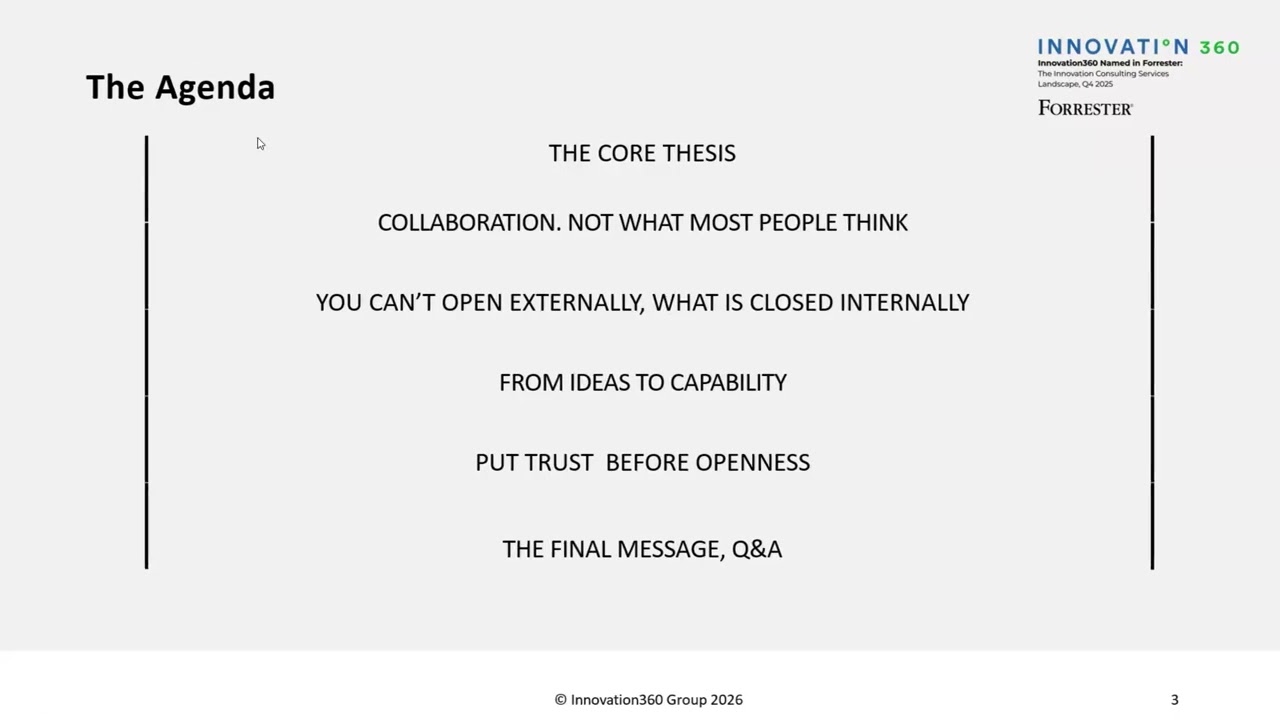 Watch · Seven Secrets, Session 5Innovating in IsolationPartnership structures, open innovation networks, and how to spot innovation theatre — with Gerry Purcell and Tord Thunman.
Step 7 — Reinforce what you want repeated
The last step decides whether the first six survive the year. People do what the system rewards, not what the strategy says — and two-thirds of organizations have no formal reward for innovation behaviour at all. Analysis of 27,003 assessments shows reinforcement is what builds the capabilities that decide what an organization can deliver; the mechanism, and a 90-day Reinforcement Audit to fix it, is in Why you don’t get the innovation you ask for.
Reinforcement is also where strategy meets metrics: a small set of innovation indicators the board actually accepts, reviewed on the same cadence as financials, wired to the goals from Step 1. That closes the loop — and restarts it.
 Watch · Seven Secrets, Session 6Ignoring IncentivesWhy two-thirds of organizations reward everything except innovation — and how recovery patterns map to ISO 56001 clauses 7.3 and 7.4.
A strategy you cannot audit is a strategy you cannot defend — to your board, your partners or yourself.
Make it auditable: innovation strategy and ISO 56001
Here is the shift that changes the economics of all seven steps: they are no longer just good practice. They map, almost one to one, onto what ISO 56001 — the first certifiable innovation management system standard — requires an organization to demonstrate: understanding of context, leadership and innovation strategy, planning, support including awareness and communication, operational processes, evaluation and improvement. Do the seven steps properly and you are not starting an ISO project from zero; you are documenting a system you already run. Our integrated approach typically reuses existing ISO 9001-style structures so that the incremental work lands at 20–40 per cent of the cost of a standalone ISO 56001 project.
Exhibit 2
#Strategy stepFailure mode it prevents (Seven Secrets)ISO 56001 anchor
1Set direction & goalsEmbarking without a mapClauses 4–5 · context, leadership
2Scan with foresightOperating with a competitive blind spotClause 4 · context, interested parties
3Choose 3–6 capabilitiesSpending without coherenceClauses 6–7 · planning, support
4Balance the portfolioBehaving in a risk-averse mannerClause 6 · opportunities & risk
5Fund evidenceFailing to test and learnClause 8 · operation
6Open the systemInnovating in isolationClause 8 · collaboration
7Reinforce & measureIgnoring incentivesClauses 7.3–7.4, 9 · awareness, evaluation
Timing matters more than it did a year ago. As we set out in Accredited ISO 56001 certification is now real, accredited certification — the kind where an accreditation body has verified the certifier’s auditors, methods and scope for ISO 56001 specifically — has moved from paper to practice, with global certification bodies now in the field. Organizations whose innovation strategy already runs on the seven steps will reach an audit-ready state first. If you want to know where you stand today, the free ISO 56000 readiness test takes three minutes; practitioners who want to lead this work professionally can pursue innovation management certification through the Licensed Practitioner program.
Make your innovation strategy real
We help leadership teams run all seven steps — from aspiration and scenario work to an audit-ready innovation management system — grounded in InnoSurvey® data from 10,000+ organizations.
Explore strategic direction & scenario planning