
Increasing your speed to market requires a holistic thinking from idea to commercialization. A major reason why organizations struggle to deliver on time is either because they make the projects consistently bigger or because they are jamming too many projects in the same system. Find out how to not be one of those organizations by reading more on the topics below.


Innovation Leader Certifications Compared: CApIL®, CIL, CInP, CIP and NPDP
Innovation leader certifications have multiplied: AIPMM’s Certified Innovation Leader, GIMI’s Certified Innovation Leader Level 4, GInI’s CInP and CCInO, IAOIP’s Certified Innovation Professional, PDMA’s NPDP – and Innovation360’s CApIL®. They are not interchangeable. This guide compares who issues them, how they are delivered, what they certify and which situations they suit – including the one most buyers overlook: whether you are certifying one person or a leadership team.
The short version
If you are an individual who wants a credential on your CV, an exam-based program such as AIPMM’s CIL, GInI’s CInP or IAOIP’s CIP will do that. If you lead product development, PDMA’s NPDP is the established standard. If your goal is that an organization – a leadership team, an innovation unit, a product organization – innovates systematically and can prove it against ISO 56001, you need a program that is applied to your own portfolio and certifies the team together. That is what CApIL® is designed for, and it is the main difference in the table below.

Comparison at a glance
| Credential | Issuer | Who it is for | Format | Delivery | Best for |
|---|---|---|---|---|---|
| CApIL® Certified Applied Innovation Leader | Innovation360 Group (contributor to ISO/TC 279 since 2013) | Leadership teams, innovation units, product and R&D leaders, HR/L&D building capability | Three program blocks applied to the organization’s own portfolio, InnoSurvey® baseline, examination, digitally verified certificate | In-company only: on-site, live online or hybrid, 45 countries, via Innovation360 and Licensed Practitioners | Organizations that want a shared method and ISO 56001-aligned competence across a team |
| Innovation360 Licensed Practitioner accreditation (IMBA → IMYB → IMGB → IMBB) | Innovation360 Group (contributor to ISO/TC 279 since 2013) | Consultants, senior advisors and leaders who want to go beyond a first certification | Four graded levels — Basic (IMBA), Yellow (IMYB), Green (IMGB) and Black Belt (IMBB) — each examined on real client cases, with blockchain-verified certificates | Cohorts on-site and live online, via Innovation360 | Individuals who want a progression path: start with IMBA, grade up to Black Belt |
| CIL – Certified Innovation Leader | AIPMM (Association of International Product Marketing and Management) | Professionals who lead or take part in innovation efforts | Course plus certification exam; self-study and exam-only options | Partner-run live courses (Informa Connect, Leoron, GrayGlobal), on-demand via Product Mastery Now | Individuals who want an exam-based innovation credential, often alongside product-management training |
| Certified Innovation Leader Level 4 | GIMI – Global Innovation Management Institute | Professionals applying manager-level learning to real organizational challenges | Submission of documented innovation ecosystem or portfolio work; 3–12 months; listed at USD 560; ISO/IEC 17024-accredited scheme | Online, as part of GIMI’s level-based pathway | Individuals progressing through GIMI’s levels who can document a real innovation program |
| CInP / CCInO | GInI – Global Innovation Institute | Innovation professionals (CInP) and C-suite innovation leaders (CCInO) | Online examinations; training through authorized partners | Authorized partners worldwide, strong presence in the Gulf | Individuals and public-sector innovation staff seeking a recognized exam-based title |
| CIP – Certified Innovation Professional | IAOIP, now operated under GIMI | Innovation professionals at associate to expert level | Exam-based levels; CIP-1 ISO/IEC 17024-accredited | Online | Individuals who want an accredited personal certification |
| NPDP – New Product Development Professional | PDMA – Product Development and Management Association | Product development and product management professionals | Body-of-knowledge exam | Exam centres and online, with partner prep courses | Product developers who want the established product-development credential |
Information compiled from the issuers’ public pages in October 2026; formats and prices change – check the issuer before deciding.
Six questions to ask before you choose
1. Are you certifying a person or an organization?
Every program in the table except CApIL® is bought one seat at a time and certifies an individual. That is fine for a career step. It does not change how a company innovates, because one certified manager returns to an uncertified team. CApIL® is run for one organization at a time: the whole leadership team or innovation unit goes through the blocks together and works on the company’s real portfolio between sessions.
2. Is the learning applied?
Exam-based credentials test knowledge of a body of knowledge. Applied programs test whether the participant can do the work. In CApIL®, the external-context analysis (PESTLED360), the capability assessment (InnoSurvey®) and the ideation and portfolio exercises (Ideation360) are done on the participant’s own organization, and the leadership team receives a benchmark report against more than 10,000 assessed organizations before the program starts. GIMI’s Level 4 also requires documented real work; AIPMM’s CIL, GInI’s CInP and PDMA’s NPDP are primarily examinations.
3. How does it relate to ISO 56001?
ISO 56001:2024 is the first certifiable innovation management standard. Organizations that aim for certification need leaders who understand the eight ISO 56000 principles and the system requirements of clauses 4–10. Innovation360 has contributed to ISO/TC 279 since 2013 and CApIL®’s third block covers how an innovation management system is governed and measured in line with ISO 56001; organizations often combine the program with an ISO 56001 readiness assessment. This also makes CApIL® — to our knowledge, today — the only innovation-leadership certification delivered by contributors to the ISO 56000 standards themselves and backed by an internationally verifiable digital certificate; if that changes, we will update this guide. Most individual credentials predate the standard and reference it only in passing. Note that ISO/IEC 17024 – the accreditation GIMI cites – concerns the certification body’s process for certifying persons, not alignment with ISO 56001.
4. Who delivers it, and in which language?
AIPMM and GInI work through training partners; quality depends on the partner. GIMI, IAOIP and PDMA are primarily online. CApIL® is delivered by Innovation360’s own faculty and by accredited Licensed Practitioners in 45 countries, in English and local languages, which matters for multi-country leadership teams.
5. What does the certificate prove afterwards?
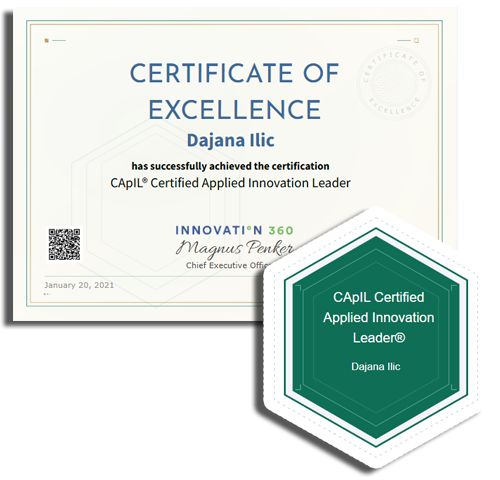
Look for a credential that can be verified. CApIL® certificates are issued digitally and can be verified online by employers and clients; most of the other programs provide digital badges as well. The bigger difference is what sits behind the badge: an exam score, or a documented program of applied work on a real organization.
6. What does it cost – per person or per organization?
Individual credentials are priced per seat (GIMI lists its Level 4 at USD 560; partner-run CIL courses are priced by the partner). CApIL® is priced per program for the whole group, after a scoping call, because format, group size and language differ between organizations. For a leadership team of ten, the comparison is not seat price but what changes in the organization afterwards.
When each one is the right choice
Choose PDMA’s NPDP if your role is product development and you want the credential hiring managers in that field recognize. Choose AIPMM’s CIL or GInI’s CInP/CCInO if you are an individual who needs an exam-based innovation title quickly, particularly if a local partner runs the course in your region. Choose GIMI’s levels if you want an accredited personal pathway and can document your own innovation program. Choose CApIL® if you are responsible for an organization’s innovation capability and want the leadership team certified together, with a measured baseline and a path to ISO 56001.
Where the path leads: IMBA to Black Belt
A first certification is rarely the end of the road. Inside the Innovation360 ecosystem the continuation is the Licensed Practitioner accreditation: four graded levels from IMBA (Basic) through IMYB (Yellow) and IMGB (Green) to IMBB (Black Belt), each examined on real client cases rather than multiple-choice questions. CApIL®-certified leaders who want to move from leading innovation inside one organization to mastering the method itself typically enter at IMBA.
Who actually reaches Black Belt? In practice, IMBB holders are senior management consultants and partners at advisory firms, heads of innovation or transformation in larger organizations, and experienced entrepreneurs who advise other companies — people who have led several full innovation programs end to end and can defend their casework at examination. It is a small group by design: each level must be earned on documented, real work, which is what keeps the credential meaningful. The accreditation path is described in detail here.
What participants say
Two assessments from participants, as published on capil.org:
“An ambitious, full-of-learning and fun certification that gave me many new insights and hands-on tools I could start using straight away.”
“As a CApIL Certified Applied Innovation Leader, I am equipped with the essentials of managing innovation, including expectations and the outcome. I highly recommend that to any professional that wants to certify themself working for an organization leading innovation, transformation, and digitalization.”
Frequently asked questions
Can an individual take CApIL®?
CApIL® is delivered as in-company programs for organizations and through Innovation360’s accredited partners. Individuals can contact Innovation360 to be connected with the next partner-run program in their region or language.
Is CApIL® the same as the Innovation360 Licensed Practitioner accreditation?
No. CApIL® certifies leaders inside organizations. The Licensed Practitioner accreditation (IMBA to Black Belt) certifies consultants who deliver Innovation360’s method, tools and programs – including CApIL® – to clients.
Does any innovation leader certification make an organization ISO 56001 certified?
No. ISO 56001 certification is granted to organizations by accredited certification bodies after an audit of the innovation management system. Leader certifications build the competence the system requires; they do not replace the audit.
Certify your leadership team with CApIL®
Tell us about your organization, the team you want to certify and your preferred format – on-site, live online or hybrid. We reply with a proposal and a price for the whole group.
Related: CApIL® in-company program · How the CApIL® program works · ISO 56001 consulting · Innovation management certifications for consultants compared